Κυριακή 12 Μαρτίου 2017

Δύο αλήθειες κι ένα ψέμα


Ένα βιωματικό σεμινάριο στη Δίβρη από γυναίκες, για γυναίκες

Μια πρωτότυπη συνάντηση γυναικών, με αφορμή την Ημέρα της Γυναίκας, πραγματοποιήθηκε στη Δίβρη την περασμένη Τετάρτη.
Διερεύνηση του βαθμού αυτογνωσίας της σύγχρονης γυναίκας, εξοικείωση με τους μύθους και τις αλήθειες γύρω από τα φύλα, αναζήτηση των ρόλων και καταγραφή των κοινωνικών επιταγών, καταμέτρηση των εμποδίων στο δρόμο των γυναικών αλλά και ενίσχυση της αυτοπεποίθησης,
ήταν τα κύρια θέματα του βιωματικού αυτού σεμιναρίου, που με χιούμορ, διάλογο και δημιουργικές δραστηριότητες, έφερε κοντά γυναίκες της Δίβρης όλων των ηλικιών.


Εκπαιδεύτρια ήταν η Λέιλα Αμπουχαλίμ από το Μαρόκο, έμπειρη κοινωνική επιχειρηματίας και σύμβουλος ευπαθών ομάδων, στα πλαίσια της συνεργασίας της με το κέντρο τοπικής ανάπτυξης «Διώνη» (SEED EURO-MED Exchange) και την κοινωνική συνεταιριστική επιχείρηση «Eco Δίβρης».


Πολύτιμη για την επιτυχία του σεμιναρίου ήταν και η συμβολή της Θεώνης Συριοπούλου από τη Δίβρη, μεταπτυχιακής φοιτήτριας στη διαχείριση & τεχνολογία ποιότητας, η οποία με τις γνώσεις και το ζεστό χαμόγελό της, αποτέλεσε ένα ζωντανό παράδειγμα του ντόπιου ανθρώπινου δυναμικού, που αγωνιά για τη βελτίωση των συνθηκών ζωής στα ορεινά χωριά και προσπαθεί έμπρακτα να αλλάξει την εικόνα απομόνωσής τους.


Το σεμινάριο έλαβε χώρα στην αίθουσα εκδηλώσεων του δημοτικού σχολείου Λαμπείας, με την ευγενική παραχώρηση της αίθουσας από τον Δήμο Αρχαίας Ολυμπίας και τον Αντιδήμαρχο κο Βασίλη Αρβανίτη.


Οι γυναίκες των απομακρυσμένων περιοχών της Ηλείας στερούνται, μοχθούν, υπομένουν. Αλήθεια αδιαμφισβήτητη.
Οι γυναίκες αυτές, κρύβουν δύναμη και θέληση. Άλλη μια μεγάλη αλήθεια.
Οι γυναίκες στα χωριά μας, είναι καταδικασμένες στη μοναξιά, την απομόνωση, την παρεμπόδιση της έμφυτης δημιουργικότητάς τους. Μια ακόμα πικρή αλήθεια, που αρχίζει να γίνεται ψέμα, χάρη στην αποφασιστικότητα των γυναικών αυτών για αλλαγή!


Σάββατο 11 Μαρτίου 2017

What Is Laila From Morocco Doing In Greece?


Join This Aspiring Social Entrepreneur In Her First 2 Weeks Of Her SEED EURO-MED Exchange

Hello, my name is Laila, I am an aspiring social entrepreneur from Morocco.
I’ve been a management consultant for five years, active social volunteer for three years, entrepreneur for two years, mentor, trainer and speaker on social entrepreneurship for one year and a member of economic consultancy committee for the council of the region of Fez-Meknes in Morocco for one month.
For two weeks I’ve been participating in the SEED EURO-MED exchange programme, funded by the European Commission and managed by Euclid Network. I collaborate with my Host Enterprise called Local Development Centre “Dione” in Ancient Olympia, Greece, which offers Business Coaching services to SMEs, HR consulting, promotion of Social Economy and Sustainable Development, and implementation of Lifelong Learning Programs.


I decided to participate in this program following my experience in the Social Entrepreneurship SEED EURO-MED Bootcamp in Tunisia, where I discovered the opportunity and the positive impact of the exchange on other participants’ enterprises.

Empowerment of Millennials              
By living the experience of participating in the ongoing project “the local development of DIVRI” in a remote village of mountainous Ancient Olympia in Elis and in collaboration with the local social enterprise “Eco Divri”, I will get the needed support, learning and network for my future social enterprise, the first centre for millennials’ empowerment in Fez city.

My project is to create an agora (co-working space and campus) for millennials that can be a part of the development processes by starting a business, practicing their passion professionally or by being an active citizen. The concept will be focused on the uniqueness of the city and its community, while creating opportunities to develop the rural areas around it to decrease migration to the city.


The first Moroccan in the village
The exchange with “Dione” provides me with the tools needed to work on the second part of my project. During my stay in Greece, I appreciated the hospitality of the locals. Of course, they had many questions since I am the first Moroccan coming to the village, but I am amazed by how open minded they are about other cultures and I love the custom of greeting everyone “Yasas” (hello in Greek) on the street.


The first nights were a little colder than I am used to in my city, but the amazing views and the purity of the air and water made me forget about it and I am getting more accustomed to cold weather and the mountainous area. But still, the lack of public transportation to bigger cities reduces the opportunity to visit more cities in this beautiful country.

During the first week of working in Divri, I got accustomed with the new environment and the social challenges that I need to work on during my exchange. I focused my actions on living the daily life of the locals and the tourists by walking around the 7 different neighbourhoods (“Machalades” in the local language), buying from the four small markets and having a local mountainous tea with honey in the 5 coffee shops of the village. I also got friendly with some locals who speak English, Arabic or tried to communicate using body language and I participated in cultural events (“Fiesta” before fasting and dance classes).

International team work
The integration process was quicker thanks to the support of my Host Entrepreneur Ms Vaso Charitopoulou, the founder and general manager of “Dione”, mr Kostas Panagoulis, the president of “Eco Divri”, and the three other team members: Alexia Karageorgis from Cyprus, cultural and natural heritage researcher; Vugar Mamedov from Azerbaijan, marketing manager and eco-consultant and Norbert Tóth from Hungary, rural developer and agricultural engineer.


The objective of my second week was the planning of the projects. We had meetings with local authorities, primary and high school staff and directors, our partners (the experts) and the active locals who are open about supporting our actions and being the main communicator with the other locals.
During my visit to the port city of Patras to meet one of our partners, I had the opportunity to visit a coworking space in the city, the POS (Patras Office Space). There, I discussed with the founder the challenges and the lessons learnt from his experiences, and we talked about potential future collaborations between our two spaces in Morocco and Greece.

From social entrepreneurship for youth to women empowerment
In Lampeia (Divri), I am planning three workshops and three projects. The first workshop is an introduction to social entrepreneurship for high school students; the second one is for recycling garbage to create a gathering space by and for the youth of the village; and the third is a safety and health in workplace workshop for farmers in collaboration with the local medical doctor.

For the projects, I am working on the women’s empowerment project meetings; Women’s health project in collaboration with Dr. Christopoulou, the Representative of the NGO W4life; and a project to increase youth engagement in village development activities.


Sustainable social impact and a piece of advice to SEED EURO-MED participants
My plan is to use developed skills and network to set up and conduct the workshops and projects in the best conditions, but the most important objective is to empower all parties to make this project a long-term action, which can still be ongoing after completing my 2-months exchange.

I want to end my testimonial with a piece of advice for the New Entrepreneurs that are planning to go on exchange: to succeed in your exchange, you need to choose the host enterprise that can add a value to your ideas and project and define together your expectations and needs.
Best regards from Greece!

Source:


Πέμπτη 23 Φεβρουαρίου 2017

International arrivals bring fresh ideas to Divri


Fresh ideas to Divri (Lampeia) in mountainous Ancient Olympia

A group of young scientists from abroad recently arrived in Divri  in order to conduct studies concerning the local development of this remote corner of the Elis regional unit in Western Greece.

At present, the team consists of Vugar Mamedov from Azerbaijan –marketing manager and eco-consultant, Laila Abouhalim from Morocco – management and social entrepreneurship consultant, Norbert Tóth from Hungary – rural developer and agricultural engineer, and Alexia Karageorgis from Cyprus – cultural and natural heritage researcher, with 3 new participants expected to be joining over the next few weeks. Their work, supported by Erasmus Interns, Erasmus for Young Entrepreneurs, and SEED EURO-MED programs, will be completed within 3 months.


The projects being conducted by this team of eager young scientists are co-ordinated by the Local Development Centre “Dione” and the local social enterprise “Eco Divri” and its president, Kostas Panagoulis. Additional support will be provided by the Holy Metropolis of Elis, whilst outreach to local schools and the local community in general is also a key factor in data collection and dissemination of findings.

The results of the studies will be reported in relevant papers, with regular progress updates appearing in local news media, both of which will be made available to the local community at no cost. The aim of this is to provide opportunities for the application of the findings and provide a basis for further studies to help improve the standard of living in this underexploited region.


Meetings with local authorities and other notable persons, and participation in cultural activities, such as Greek dance classes, are already underway, helping to integrate the newcomers into the village and provide insights to the challenges that the local community faces.
Direct communication with the local community as a means of encouraging dialogue and participation is integral to the achievement of significant and applicable findings, which can provide clear guidelines for future local development.


 Alexia Karageorgis
Cultural & Natural Heritage Researcher, in collaboration with Vaso Charitopoulou (head of “Dione” in Ancient Olympia)
email: alexiakarageorgis@hotmail.com

photos: Kostas Panagoulis, “Eco Divri” social enterprise

Τετάρτη 22 Φεβρουαρίου 2017

A dazzling ecosystem around Lampeia


Three weeks in Greece as an 
Erasmus student 

It’s January the 22nd, 15:30 in the afternoon. The sun has just started to set, and greyish clouds are gathering around the hill-tops covered in snow. I am riding a bus in Western-Greece, on the Peloponnese peninsula, just passing the ancient oak forest of Foloi on the southwest, which is followed by the bulging mountains of Arcadia. As I am looking out of the window, I can see the peak of mount Erymanthos in the north, but it soon fades into the coverage of lower cliffs, because the bus is heading down on the 111th National Road. Approaching the valley, I see the village and its houses, capped with orange rooftops, the disappearing sun still shines a light on the solar panels. About 460 people are living on these peaceful hill-sides, 803 meters above sea level. I arrived in Lampeia. 


This was my first experience with this village, resting around beautiful nature. The area is highly rich in natural resources, that can be seen at first sight. The serpentine streets and the neighbourhoods enjoy crystal-clear water from the nearby mountains, and the streams enmesh the whole settlement. The currents are joined together at the bottom of the valley, where a little dam is generating electricity from their flow. Sadly, it is privately owned, so the energy is not used here. 

The houses are traditionally made from cob, more specifically, from limestone. I was surprised when I noticed, how many buildings are equipped with sustainable technologies, such as solar panels, which are mainly used for generating hot water. At first glance, with these ecological solutions, the stories seem to be true about the people of Arcadia, the part of which Lampeia used to be in ancient times: locals lived in harmony with nature, only took as much as they needed and were completely self-sufficient. Later, as it turned out, the situation is a lot more complicated. 

In the centre of the village one can find a post office, pharmacy, several markets and catering places. You can try the brilliant local bakery products, purchase meat or dairy products from locally raised animals in two butcheries, or just buy your groceries from the three mini-markets. The daily lives of the people are concentrated here, in the centre. “Agora”, they call it in Greek. 

They are charming people, especially if we are open with them and take the effort to greet them with a friendly “Kalimera” in their own language. Then there are three Greek restaurants, where you will find delicious, traditional food and hospitality. I highly recommend visiting them, if the dear reader comes to Lampeia. Sadly, credit card is not accepted at any of them at the moment, but they are the best places to regain our strength after a hard hike in the mountains. 
The visitors of the area are clearly attracted to the natural aspects around the village, but besides the few outdoor activities, such as mountain climbing or fishing in the Erymanthos river, there are not many other free-time activities, especially in winter. The substantial potentials of the region clearly lie in its location, so all development direction must be determined in light of this. The hills are filled with wildlife, history and religious places. Considering chapels alone, there are about 120 scattered in- and out of the village. The natural and the built environment are equally captivating. This is one of the reasons why the mountains and forests around Lampeia are Birds Directive sites by the European Natura 2000 network, so their preservation is not just beneficial, but necessary. 
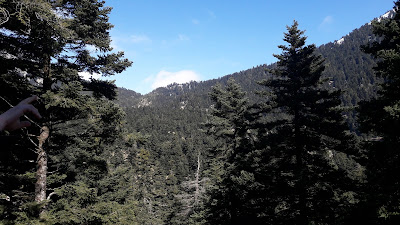

Right after leaving the edges of the settlement, fir forests surround the mountain slopes and adventure finds you straightaway. The terrain is beautiful, the air is refreshing. Stepping into the woods is a heart lifting experience, I found my inner peace right away and became very inspired about my work here. Exploring these environments made me more sure that it’s our responsibility to actively work towards preserving them for future generations. After all, we inherited this planet from our ancestors, so we ought to keep it as pure as we received it, at the least, but in this case, better to strive for a little more. 

There should be even more organized trekking opportunity, and a wider palette of outdoor opportunities to choose from, so the visitors would more likely spend extra time here. Still, the carefree enjoyment of the nature here is overshadowed, one could even say, -spoiled-, by a very important matter, that I quickly observed: the situation about garbage handling. 
When one takes a closer look, the seemingly untouched nature is not nearly as well-kept as it should be. Lampeia’s inhabitants’ problem comes from the lack of environmental awareness. The ​waste management in the countryside, and the general attitude about it is drastic. I believe it is neglected from both the side of the government and residents also. Walking through the streets and neighbourhoods, I have seen courtyards and fields where proper waste disposal is not solved nor dealt with. 


This can seriously damage the fertility of the land, human health and the natural habitat of animals around the area. It harms the integrity of the entire ecosystem around the village, can lead to extreme soil degradation, and is a bad impression to visitors, coming here to enjoy nature.  
Furthermore, I have seen many unused fields and gardens, where the soils are waiting to be cultivated. With these endless supplies of water from the mountains, the settlement really has the potential to be more self-sufficient and economically strong. As I found out more information, I learnt, that this was not always the situation. 

Lampeia functioned as a bustling trading centre in the past, selling a great deal of local goods, ranging from a significant amount of livestock products, to the fine crafts of the local artisans. With globalization and the migration of youth towards cities, the village became isolated and lost its strong economic position, which further increased population loss. Between 2001 and 2011 the number of the residents decreased by 30%. When asking about this situation, a local business owner stated: “The main reason behind this is the fact that there are more people dying than being born. Young folk nowadays are afraid to start a family because they either think they do not have enough income to support themselves, or are just afraid of being committed to someone and possibly miss out on experiences at a young age. This I blame on our modern world, and on the mass media.”  
Until now, I have seen two types of very distinguishable people. A significant part of the locals are very simple, rural people, the other part consists of modern people who sadly are more frustrated about the often-tedious life in the village. 

Our vision for prospective projects should be well-balanced between connecting the village more to the world, while not letting in the negative effects of capitalism/globalism. Mass media and global marketing should not set its foot in such a village where the simple local values are already increasingly unpopular, but worth preserving and promoting. 

Furthermore, the fact should also be considered, that Lampeia can also benefit from certain globalization effects. We can’t rule out technology, from which locals could surely benefit. Maintaining the peaceful and simplistic life is just as important, as the diversification of local economy. 
If awareness is raised about the unexploited opportunities, provided by their environment, the locals can achieve a higher level of economic independence and diversity, thus the probability to settle here would become more appealing. This way the youth would be more attracted to stay here, and work for their own household, rather than rent a flat in the city. I see that the idea of staying in this rural area is nowadays more unfavourable than desired. Development goals should be set, so that people would prefer to live and work here, by creating sufficient opportunities for all age groups. 

I think the best way to look at the situation is that we need Lampeia as self-sufficient as possible, while at the same time connecting it to a higher level of globalization. If we want the youth to live and work here, or at least, live here and work elsewhere, we need them to feel like they can always retreat here to enjoy the peacefulness, but at the same time, they are still in an area of civilization. The businesses need the global view, which can direct local action. 

Now, there are few things that are holding back the younger generations from moving to the cities. The current job opportunities are just not enough to occupy everybody. Large families and the strong communities still have strength to keep the youth here, but -in my opinion- if they are not satisfied with their way of life here, or do not have a sense of purpose, they will continue leaving the village. This is a common problem in remote villages, where keeping yourself busy and creative is often problematic. 
From 2010 to 2011 the overall number of suicides increased by 27% in the whole population of Greece. The number is so high for that year because deaths by suicide doubled among women. What is troubling is, that these occurrences are rising by 5-6% every year, based on data published by the Hellenic Statistical Authority. I find also that these numbers are closely related to the growing unemployment rate, even more to long-term unemployment difficulties. To work against such problems, meaningful purposes must be set, towards which people can work with heart. Because to my mind, happiness comes from useful and helpful work, as a result; not when happiness itself is the purpose. Fortunately, I believe this village is in a privileged position, when these kinds of goals need to be set. It is filled with positive values. 

Being objective, I had my negative experience also, with the host of my accommodation, during my first week of staying here. The owner of my housing showed very unprofessional behaviour regarding our financial agreement. After settling on the monthly fee of my accommodation, I received multiple harassment about overusing heating and electricity. Two days went by, and even though we agreed on an “all costs included” deal, after shutting off the central heating firstly, he kept asking for more money, now, for electricity. For the sake of transparency, let it be said, that heating oil prices are through the roof now in Greece, so his concerns were not for nothing. Yet, I think they were incorrect and this attitude is amateurish. It ruins the overall experience for someone staying here, and hurts the local economy, because visitors are less likely to return if they receive this kind of treatment. In this case, I am assuming it comes from the lack of professionalism and wrong attitude about hosting. 

Due to the terrain’s asymmetry, the distance or height between the 7 neighbourhoods of the village can be significant to some people. Because of this, they became both closed and open communities at the same time, having their own chapels and social gatherings. Therefore, this can be an obstructing factor when expecting cooperation between neighbourhoods in the way of public work. Some level of ignorance could be expected, but so far, the locals were very welcoming towards new faces.  
With an upcoming survey, the village’s social structure and opinion about social, cultural, economic and ecological matters will be analysed. It will provide important information for development directions to align local needs with global demand. I consider the bottom-up organizing in the village very important; in the history of humanity, most significant changes were always achieved by small and local initiatives, willing to approach matters from new perspectives. I believe Lampeia has this potential. 

To start working against depopulation and environmental degradation, I set three goals towards my work which are completely interconnected with each other: 

-Employment growth, through diversifying the local business and entrepreneurship palette. Introducing new standards in business creation, through promoting and unlocking the existing opportunities that are provided by the natural values of the area. Business consulting to help small and medium-sized enterprises increase the efficiency of sales, local product marketing, entry of new businesses, producers' organizations. Restoring local industry and handicraft. Promoting the need for ecological, social enterprises, companies which would provide additional outdoor services, transportation providers, hiking organizers, bicycle and other transportation vehicle rental businesses. Organizations for conducting religious tourism. Sports and event planning entrepreneurs and activists. Household farming production, local product creation. 

-Improving the life-quality, via further distributing implementable sustainable technology ideas, designing youth and adult alternative education, training for higher quality universal knowledge. Providing alternative education about local needs: animal husbandry focus, harmonized land use, food production for capacity growth. Lobbying for further infrastructure expansion. Human resource growth, network building in health and social projects, culture and heritage conservation and the promotion of them. Inviting or even training new social workers and caretakers. Preventing isolation and purposelessness through strengthening community cohesion. 

-Conservation, development and promotion of the environmental values of Lampeia: We need to discourage inappropriate current activities, such as the incorrect disposal of trash, to ensure that environmental systems can continue to function and sustain future generations of humans, as well as other creatures. Promoting more organic agricultural production, organic farming. A new whole professional sector can be built, on the obligation of protection and passing on the landscape for present and future generations. 

These three should be our pillars, on which we will base our more specific objectives with “Dione”, the local development centre under which I came to Lampeia as a Project Management Assistant for a 3 months project, to realize the dimensions of rural development in collaboration with the social enterprise "Eco Divri", my fellow Erasmus interns and the people of Lampeia. Our first step in this will be building relationships with the locals, and assessing their needs through a detailed survey. 


  • Norbert Tóth, Erasmus Intern from Hungary, University of Debrecen, Faculty: Business and administration / rural development, agricultural engineering, in collaboration with "Dione" Local Development Centre in Ancient Olympia 
  • Copyediting: Alexia Karageorgis, Cultural & Natural Heritage Researcher 
  • Supervisor: Vaso Charitopoulou (Head of “Dione”) 


Κυριακή 19 Φεβρουαρίου 2017

Νέα πνοή στην Ορεινή Ηλεία


Φρέσκες ιδέες από 
ομάδα νέων επιστημόνων

Μια ομάδα νέων επιστημόνων από το εξωτερικό, ειδικευμένοι στα πεδία: Αγροτική Οικονομία-Περιβάλλον-Αειφορικός Σχεδιασμός, Οικονομικές Επιστήμες-Μάρκετινγκ, Διαχείριση Πολιτιστικής Κληρονομιάς-Γεωγραφικά Συστήματα-Συντήρηση πολιτιστικών μνημείων, και Κοινωνική Οικονομία-Επιχειρηματικότητα,
έχουν ξεκινήσει από τα τέλη Ιανουαρίου να εργάζονται εντατικά στην Ορεινή Ηλεία με επίκεντρο τη Δίβρη,
προκειμένου να εκπονήσουν βιώσιμες μελέτες για την τοπική ανάπτυξη και τη βελτίωση των συνθηκών ζωής στην απομακρυσμένη αυτή γωνιά της Ηλείας.


Το έργο τους, το οποίο υποστηρίζεται από τα προγράμματα Erasmus Interns, Erasmus for Young Entrepreneurs και SEED EURO-MED, θα ολοκληρωθεί σε 3 μήνες.

Οι νέοι αυτοί επιστήμονες, εργάζονται ως ομάδα υπό το συντονισμό του κέντρου τοπικής ανάπτυξης "Διώνη", με την υποστήριξη της κοινωνικής συνεταιριστικής επιχείρησης “Eco Δίβρης” και του προέδρου της Κώστα Παναγούλη, καθώς και με την αρωγή της Ιεράς Μητρόπολης Ηλείας.  
Τα αποτελέσματα του έργου, τα οποία θα αποτυπωθούν σε εμπεριστατωμένες μελέτες, θα είναι στη διάθεση της τοπικής κοινωνίας και κάθε ενδιαφερόμενου φορέα δωρεάν, με σκοπό την αξιοποίηση των συμπερασμάτων και προτάσεων που θα εμπεριέχουν.
  

Για την ακόμα πιο αποτελεσματική και εποικοδομητική αλληλεπίδραση των νέων επιστημόνων με την τοπικό πληθυσμό, αλλά και την ενθάρρυνση της ενεργούς συμμετοχής όλων, ώστε να διευκολυνθεί στο μέγιστο βαθμό το εγχείρημα, έχουν ήδη αρχίσει να πραγματοποιούνται επαφές και συναντήσεις με αντικείμενο το γόνιμο διάλογο και την ανταλλαγή απόψεων.


Σκοπός είναι να εξεταστούν όλες οι προοπτικές και οι επιμέρους λεπτομέρειες για μια έμπρακτη συνεργασία που θα ωφελήσει την περιοχή μας.

Κυριακή 12 Φεβρουαρίου 2017

"Dione" shares experience with Serbia on Online Tools


 “Online tools in youth work and non-formal learning” training course

 “Online tools in youth work and non-formal learning” was a seven days long Training course that took place on the mountain Kopaonik in Serbia, from 20th to 26th of January 2017. 
The training course that was coordinated by the Educational Center of Krusevac, gathered together 30 youth workers, coordinators, leaders and activists, who are actively involved in youth work, coming from 10 different countries, CoE member states: Serbia, Montenegro, Cyprus, Croatia, Albania, Macedonia, Turkey, Greece, Bosnia & Herzegovina, and Romania.

“Dione” local development centre, located in the area of Ancient Olympia in Ileia county, participated in the “Online tools in youth work and non-formal learning” training course by being represented by Alexia Karageorgis and Dalibor Selucký.


The main objective of this project was to promote existing and apply new tools for improving the quality of youth work and non-formal learning. The training course empowered the participants to use more efficiently and extensively on line tools in their activities, both for improving the educational process and also for disseminating the material developed and results achieved further to wider communities.


MAIN THEMES:
· To strengthen the role of youth work in increasing employability and fighting unemployment of young people through development and practice of new non formal education tools.
·   To develop informational and communication tools in the field of youth work and non formal learning, through an open educational resource and virtual cooperation.
·    To strengthen cooperation and exchange of practice between youth workers in the field of improving the quality of youth work and non-formal learning on national and European level.
 

The detailed training program is presented on http://youth-work.me/

Vaso Charitopoulou, founder & general manager of “Dione”
email: vasso-charitopoulou@hotmail.com
Alexia Karageorgis, Cultural & Natural Heritage Researcher from Cyprus
email: alexiakarageorgis@hotmail.com
Dalibor Selucký, New Entrepreneur under the EYE programme from Czech Republic, founder of “Tranquila Casa”
email: dalibor.selucky.tc@gmail.com

Τετάρτη 14 Δεκεμβρίου 2016

Εργαστήριο για την αυτάρκεια και την αειφορία


Από την ομάδα Βιοκλιματικής Δόμησης “cob” &  το ftiaxno.gr σε συνεργασία με την 
«Eco Δίβρης» ΚοινΣΕπ


Προσπαθώντας να σκιαγραφήσουν ένα μοντέλο ζωής με γνώμονα την αειφορία, την αυτάρκεια, το χαμηλό ενεργειακό αποτύπωμα και την ποιότητα ζωής,
η κοινωνική συνεταιριστική επιχείρηση “Eco Δίβρης” διοργανώνει το τριήμερο των Φώτων και σε συνεργασία με την ΚοινΣΕπ Βιοκλιματικής Δόμησης “cob” (www.cob.gr), το ftiaxno.gr και το κέντρο τοπικής ανάπτυξης «Διώνη»,
βιωματικό εργαστήριο στη Δίβρη Αρχαίας Ολυμπίας.


Θεματολογία:
-Συσκευές μαγειρέματος χαμηλού αποτυπώματος (ηλιακοί φούρνοι, ξυλόφουρνοι, dutch ovens, rocket stoves, πυρομάχια).
-Κατασκευές επεξεργασίας και συντήρησης της τροφής (ηλιακά ξηραντήρια, καπνιστήρια, κελάρια).
-Στέγαση (κατασκευές με φυσικά υλικά).
-Ενέργεια (ανεμογεννήτριες, βιοαέριο, ηλιακοί θερμοσίφωνες).
-Επεξεργασία, συντήρηση και αποθήκευση τροφίμων (αποξήρανση, κονσέρβες, κομπόστες, τουρσιά, παστά, καπνιστά, ψωμιά, τυριά, ζυμαρικά).
-Εδώδιμα μανιτάρια (συλλογή, αποθήκευση, αποξήρανση, σάλτσες, τουρσιά).
-Βότανα (συλλογή, αποθήκευση, σκευάσματα).
-Είδη υγιεινής και καθαριστικά.

Οι περισσότερες από τις δραστηριότητες θα είναι βιωματικές και κάποιες μάλιστα καθετοποιημένες, από τη συλλογή δηλαδή των υλικών στο φυσικό περιβάλλον, μέχρι και την ολοκλήρωση της κατασκευής.

Χρόνος: Από το απόγευμα της Πέμπτης 5, μέχρι το απόγευμα της Κυριακής 8 Ιανουαρίου 2017.

Τόπος: Στην κατασκήνωση της Ιεράς Μητρόπολης Ηλείας, με την ευγενική παραχώρηση του χώρου στην «Eco Δίβρης ΚοινΣΕπ», που βρίσκεται στα Λάμπεια Όρη του Ερυμάνθου, συνολικής δυναμικότητας 80 ατόμων.

Εξοπλισμός: Λόγω της εποχής, θα χρειαστούν ζεστά ρούχα. Για τις εξορμήσεις θα χρειαστούν αρβυλάκια, αδιάβροχο, παγούρι, σουγιάς, σακίδιο πλάτης. Επίσης θα χρειαστούν ζεστοί υπνόσακοι.

Διατροφή: Χορτοφαγική με βιολογικά προϊόντα και με τροφές που θα συλλεχθούν στην ύπαιθρο.


Κόστος συμμετοχής:
100€ ανά άτομο, ποσό που συμπεριλαμβάνει τη διαμονή και τη διατροφή.

Για πληροφορίες και δηλώσεις συμμετοχής:
Με email στο kostas@cob.gr ή στο kostpanagouli@yahoo.gr, στο οποίο να αναγράφετε το όνομά σας, ένα τηλέφωνο επικοινωνίας, από πού θα έρθετε και αν θα διαμείνετε στο καταφύγιο.
Εναλλακτικά τηλεφωνήστε στο 6932-568126 (Κώστας Κοντομάνος) ή στο 6937-009616 (Κώστας Παναγούλης).

Πρόσθετες πληροφορίες στα: